 Demos
 Colors
 Docs
 Support


Variable Volume Micropipette: Complete Guide to Working Principle, Uses, Types, Benefits, Selection & Best Practices
Introduction
A good variable volume micropipette combines accuracy, precision, ergonomic handling, smooth operation, durability, and reliable volume adjustment. Modern micropipettes are designed to make repetitive pipetting easier while reducing the possibility of operator errors.

What Is a Variable Volume Micropipette?
A Variable Volume Micropipette is a precision laboratory instrument used to measure and transfer small volumes of liquid. The volume can be adjusted by the operator within the specified range of the micropipette.
For example, a micropipette designed for a range of 10–100 µL can generally be adjusted to dispense different volumes within that operating range, such as:
- 10 µL
- 25 µL
- 50 µL
- 75 µL
- 100 µL
The exact performance depends on the instrument’s specifications, operating technique, calibration condition, and the selected volume.
Variable volume micropipettes are commonly referred to as:
- Adjustable micropipettes
- Variable volume pipettes
- Adjustable volume micropipettes
- Variable micropipettes
- Laboratory micropipettes
- Precision micropipettes
- Air displacement micropipettes
The basic purpose remains the same: to provide controlled and repeatable transfer of small liquid volumes.
Why Is a Variable Volume Micropipette Important?
Laboratory experiments frequently require volumes that are much smaller than what conventional measuring cylinders or glass pipettes can accurately handle.
For example, a laboratory procedure may require:
- 5 µL of reagent
- 10 µL of sample
- 25 µL of buffer
- 50 µL of biological solution
- 100 µL of DNA preparation
- 200 µL of reaction mixture
- 500 µL of laboratory reagent
- 1,000 µL of solution
Using an instrument designed specifically for small-volume liquid handling makes the process more controlled and repeatable.
A variable volume micropipette is particularly useful because one instrument can accommodate multiple volume requirements within its specified range.
Instead of keeping a separate fixed-volume pipette for every individual volume, laboratories can use different variable-volume models covering appropriate ranges.
This can make liquid handling more convenient and can help laboratories organize their equipment more efficiently.
Variable Volume vs Fixed Volume Micropipette
One of the most common questions is the difference between a variable volume micropipette and a fixed volume micropipette.
Variable Volume Micropipette
A variable volume micropipette allows the user to select the required volume within the pipette’s specified range.
For example:
20–200 µL
The user can select a volume such as 20, 50, 100, 150, or 200 µL, depending on the application and the manufacturer’s specified operating range.
Advantages
- Flexible volume selection
- Suitable for multiple applications
- Useful for laboratories handling different sample volumes
- Reduces the need for many fixed-volume pipettes
- Convenient for routine laboratory work
Fixed Volume Micropipette
A fixed-volume micropipette is designed to dispense one specified volume.
For example:
100 µL fixed volume
The pipette is intended for applications requiring that particular volume.
Advantages
- Simple operation
- Useful for repetitive protocols
- Can be convenient where one volume is used continuously
- Reduced volume-setting steps
Which One Should You Choose?
The answer depends on the application.
If a laboratory regularly works with different liquid volumes, a variable volume micropipette can provide greater flexibility.
If a process repeatedly requires exactly one volume, a fixed-volume pipette may be a suitable choice.
Many professional laboratories maintain both types.
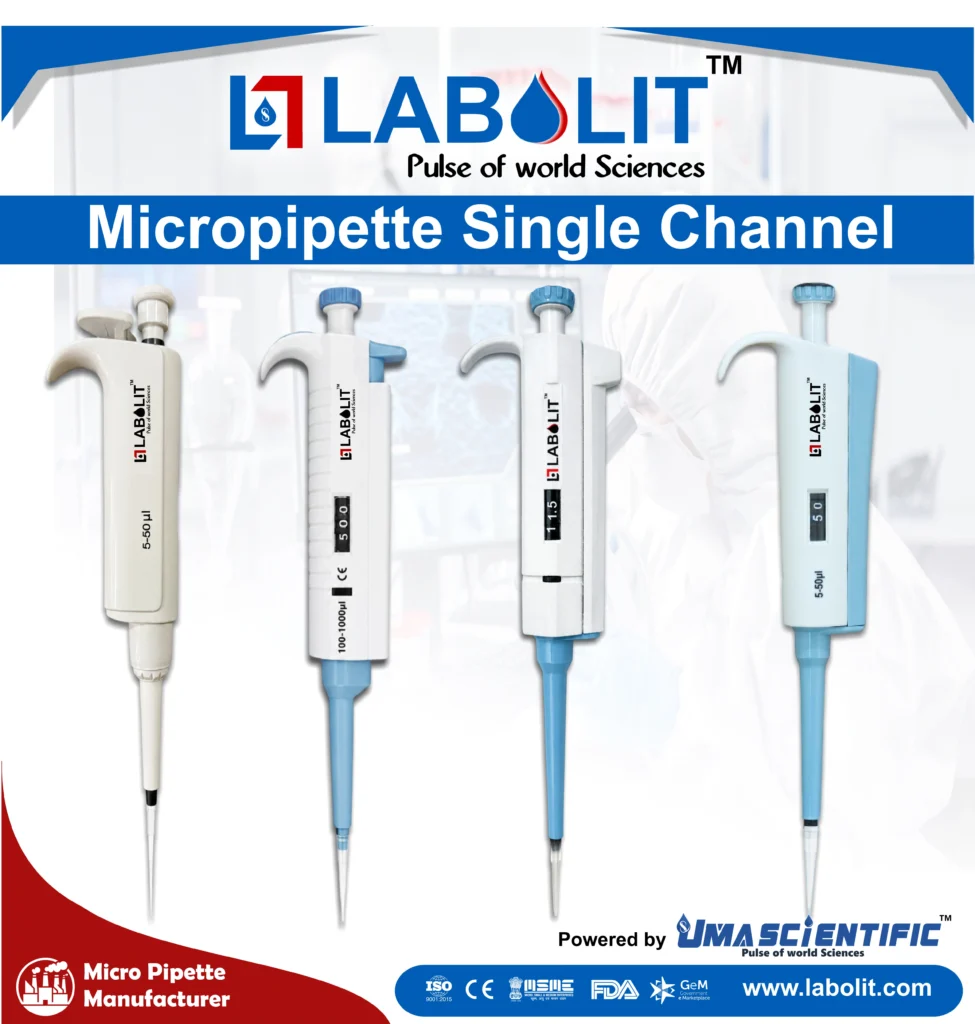
Working Principle of a Variable Volume Micropipette
Most conventional variable volume micropipettes used in laboratories operate using an air displacement principle.
The internal piston mechanism changes the volume of air between the piston and the liquid. When the pipette tip is immersed correctly into the liquid and the plunger is operated, the pressure difference allows the liquid to enter the disposable tip.
The general process includes:
- Selecting the required volume
- Attaching an appropriate pipette tip
- Pressing the plunger to the first stop
- Immersing the tip into the liquid
- Slowly releasing the plunger
- Allowing the liquid to enter the tip
- Moving the pipette to the receiving vessel
- Pressing the plunger to dispense the liquid
- Using the second stop where appropriate to expel remaining liquid
- Ejecting the used tip
The actual operating technique should always follow the manufacturer’s instructions.
Main Components of a Variable Volume Micropipette
A variable volume micropipette contains several important components.
1. Plunger Button
The plunger is pressed by the operator to aspirate and dispense liquid.
A well-designed plunger should provide smooth movement and controlled operation.
2. Volume Adjustment Mechanism
This mechanism allows the operator to select the desired volume.
The selected value should be easy to read and should remain stable during normal operation.
3. Volume Display
The volume display shows the selected pipetting volume.
Clear volume visibility is particularly useful when performing repetitive work.
4. Piston Mechanism
The piston is an important internal component responsible for creating the displacement required for liquid aspiration and dispensing.
5. Tip Cone
The tip cone is the part where the disposable pipette tip is attached.
A secure connection is important for reliable pipetting.
6. Tip Ejector
Many micropipettes include a tip-ejection mechanism that allows the user to remove the used tip without directly touching it.
7. Finger Rest
An ergonomic finger rest can help support the hand during repetitive pipetting.
8. Lower Assembly
The lower portion contains the components responsible for connecting the tip and controlling liquid movement.
Different Volume Ranges of Variable Volume Micropipettes
Variable volume micropipettes are available in different volume ranges.
Common ranges include:
- 0.1–2.5 µL
- 0.5–10 µL
- 2–20 µL
- 5–50 µL
- 10–100 µL
- 20–200 µL
- 100–1,000 µL
The appropriate range depends on the required application.
For example, a laboratory working primarily with very small volumes may require a low-volume micropipette, while routine reagent preparation may require a larger-volume model.
It is generally important to select a pipette where the required working volume falls comfortably within the instrument’s specified range.
How to Select the Correct Volume Range
Selecting the correct volume range is an important part of accurate pipetting.
Suppose the laboratory regularly transfers approximately 75 µL.
A micropipette covering:
10–100 µL
may be appropriate.
If the laboratory regularly transfers approximately 180 µL, a:
20–200 µL
model may be considered.
For approximately 800 µL, a:
100–1,000 µL
model may be suitable.
The exact choice should also consider the manufacturer’s accuracy and precision specifications at the intended volume.
Applications of Variable Volume Micropipettes
Variable volume micropipettes are used across a wide range of laboratory disciplines.
Molecular Biology
Micropipettes are extensively used in molecular biology laboratories for handling:
- DNA samples
- RNA samples
- Buffers
- Enzymes
- Primers
- PCR reagents
- Reaction mixtures
Small volume accuracy can be particularly important in molecular biology workflows.
Biotechnology
Biotechnology laboratories use micropipettes for:
- Sample preparation
- Reagent transfer
- Assay preparation
- Cell culture procedures
- Molecular analysis
- Research experiments
Pharmaceutical Laboratories
Pharmaceutical laboratories may use micropipettes during:
- Research and development
- Formulation studies
- Analytical preparation
- Quality control
- Sample preparation
- Laboratory testing
Clinical Diagnostic Laboratories
Micropipettes are widely used for controlled handling of laboratory samples and reagents.
They may be used in workflows involving:
- Diagnostic assays
- Blood sample processing
- Biochemical testing
- Immunoassays
- Molecular diagnostic procedures
Microbiology
Microbiology laboratories use micropipettes for:
- Culture-related procedures
- Reagent preparation
- Sample transfer
- Dilution procedures
- Molecular microbiology
- Research protocols
Academic Laboratories
Schools, colleges, universities, and research institutions use micropipettes for educational experiments and research activities.
Food and Beverage Testing
Laboratories involved in food testing may use micropipettes during:
- Sample preparation
- Chemical analysis
- Microbiological testing
- Quality control
- Research procedures
Environmental Testing
Environmental laboratories can use micropipettes for controlled transfer of samples and reagents during analytical procedures.
Advantages of Variable Volume Micropipettes
1. Flexible Volume Selection
The biggest advantage is the ability to change the volume according to the application.
2. Multiple Applications
One micropipette can be used for different volumes within its specified range.
3. Efficient Laboratory Workflow
Variable-volume operation can reduce the need to switch between numerous fixed-volume instruments.
4. Precise Liquid Handling
When correctly calibrated and operated, a quality micropipette can provide highly controlled liquid transfer.
5. Ergonomic Operation
Modern designs can reduce hand strain during repetitive pipetting.
6. Repeatability
A properly maintained micropipette can provide consistent results across repeated operations.
7. Easy Volume Adjustment
The volume setting can generally be changed quickly according to the experimental protocol.
8. Broad Laboratory Applications
Variable-volume micropipettes can be used in research, diagnostics, pharmaceutical laboratories, biotechnology, microbiology, and educational laboratories.
Accuracy and Precision in Micropipetting
Two important terms associated with micropipettes are accuracy and precision.
What Is Accuracy?
Accuracy refers to how close the dispensed volume is to the intended or true volume.
For example, if the target volume is 100 µL, dispensing a volume very close to 100 µL indicates good accuracy.
What Is Precision?
Precision refers to how consistently the micropipette produces the same volume during repeated measurements.
For example, if repeated dispensing produces very similar results, the pipette demonstrates good precision.
A high-quality micropipette should be designed to support both accurate and repeatable liquid handling when used within its specified conditions.
Why Pipetting Technique Matters
Even an advanced micropipette can produce inconsistent results if it is operated incorrectly.
Operator technique can influence pipetting performance.
Important factors include:
- Pipette angle
- Immersion depth
- Plunger speed
- Tip selection
- Pre-wetting
- Temperature
- Liquid characteristics
- Holding time
- Volume range
- Pipette calibration
Therefore, laboratory personnel should receive appropriate training in micropipette operation.
Step-by-Step Guide to Using a Variable Volume Micropipette
Step 1: Select the Appropriate Pipette
Choose a pipette whose volume range covers the required liquid volume.
Step 2: Set the Volume
Adjust the volume mechanism carefully.
Do not force the volume adjustment beyond the specified range.
Step 3: Select the Correct Tip
Use a compatible disposable pipette tip.
The tip should fit securely on the tip cone.
Step 4: Attach the Tip
Press the pipette into the tip using controlled pressure.
Avoid excessive force.
Step 5: Aspirate the Liquid
Press the plunger to the appropriate first stop before immersing the tip.
Place the tip into the liquid at the recommended depth.
Slowly release the plunger to aspirate the liquid.
Step 6: Dispense the Liquid
Move the pipette to the receiving vessel.
Press the plunger smoothly to dispense the liquid.
Where required by the technique, use the second stop to expel residual liquid.
Step 7: Eject the Tip
After dispensing, use the tip ejector to remove the disposable tip.
Avoid touching contaminated tips with bare hands.
Common Pipetting Mistakes
Several common mistakes can affect pipetting performance.
1. Using the Wrong Volume Range
Selecting an unsuitable pipette can reduce performance.
2. Setting the Volume Beyond the Range
Never rotate the volume adjustment beyond the manufacturer’s specified range.
3. Using an Incorrect Tip
An incompatible or poorly fitted tip can affect liquid handling.
4. Immersing the Tip Too Deeply
Excessive immersion can influence aspiration behavior.
5. Releasing the Plunger Too Quickly
Rapid plunger release can cause inconsistent aspiration or splashing.
6. Holding the Pipette at an Incorrect Angle
Maintaining the recommended orientation helps improve consistency.
7. Ignoring Temperature
Very large temperature differences between the pipette, tip, liquid, and environment can influence measurement performance.
8. Failing to Calibrate
Regular calibration is essential for maintaining confidence in pipette performance.
9. Reusing Disposable Tips Incorrectly
Cross-contamination can occur when tips are reused inappropriately.
10. Rough Handling
Dropping or mishandling a micropipette can affect its mechanical condition.
Variable Volume Micropipette Calibration
Calibration is an important part of laboratory quality management.
A micropipette should be checked periodically according to:
- Laboratory SOP
- Usage frequency
- Application requirements
- Manufacturer recommendations
- Quality-management requirements
- Internal laboratory policies
Gravimetric calibration is commonly used for checking liquid-delivery performance under controlled conditions.
During calibration, water is typically dispensed and weighed using an appropriate analytical balance, with environmental factors considered according to the applicable procedure.
Calibration should be performed by trained personnel or an appropriately qualified calibration service.
How Often Should a Micropipette Be Calibrated?
There is no single interval that applies to every laboratory.
Calibration frequency may depend on:
- Frequency of use
- Type of liquid
- Required accuracy
- Laboratory quality system
- Risk associated with the application
- Manufacturer recommendations
- Previous calibration results
Laboratories working under regulated quality systems may establish documented calibration schedules.
Maintenance of Variable Volume Micropipettes
Proper maintenance helps extend the service life of a micropipette.
Regular Cleaning
Clean external surfaces according to the manufacturer’s instructions.
Inspect the Tip Cone
Check for damage, contamination, or wear.
Check the Plunger
The plunger should move smoothly.
Inspect the Volume Mechanism
Ensure that volume adjustment operates correctly.
Prevent Chemical Damage
Some chemicals can damage pipette components. Always check chemical compatibility.
Store Properly
When not in use, store the pipette in a suitable stand or storage system.
Proper storage can help protect the instrument from accidental damage.
Fully Autoclavable Variable Volume Micropipettes
Some modern micropipettes are designed with autoclavable components or fully autoclavable construction.
A fully autoclavable micropipette is designed so that the specified complete pipette assembly can undergo autoclave sterilization according to the manufacturer’s instructions.
This can be especially useful in laboratories where contamination control is important.
However, users should always confirm:
- Whether the entire pipette is autoclavable
- The approved temperature
- Exposure duration
- Drying requirements
- Disassembly requirements
- Cooling requirements
Never assume that a micropipette is fully autoclavable simply because individual components are autoclavable.
Air Displacement Variable Volume Micropipette
An air displacement micropipette uses an air cushion between the piston and liquid.
This design is widely used for aqueous and many routine laboratory liquids.
Air displacement micropipettes are popular because they offer:
- Easy operation
- Flexible volume selection
- Broad laboratory applications
- Disposable tip compatibility
- Convenient routine liquid handling
For highly viscous, volatile, foaming, or otherwise challenging liquids, laboratories should consider the manufacturer’s recommendations and the appropriate pipetting technique or technology.
Choosing a Variable Volume Micropipette for Your Laboratory
Several factors should be considered before purchasing a micropipette.
1. Required Volume
Identify the typical volume range used in your laboratory.
2. Accuracy Requirements
Determine the level of accuracy and precision required by your applications.
3. Frequency of Use
For high-frequency pipetting, ergonomics and durability become especially important.
4. Tip Compatibility
Check the availability and compatibility of pipette tips.
5. Autoclavability
If sterilization is required, consider an autoclavable model.
6. Ergonomics
A comfortable grip and smooth plunger action can be valuable for repetitive work.
7. Calibration Support
Choose a manufacturer or supplier that can support calibration and service requirements.
8. Construction Quality
The materials and mechanical construction should be appropriate for the intended laboratory environment.
9. Volume Range Options
A complete range of pipettes allows laboratories to select suitable instruments for different applications.
10. After-Sales Support
Technical support, spare parts, maintenance, and service availability should also be considered.
Variable Volume Micropipette for Research Laboratories
Research laboratories frequently work with multiple experimental protocols.
One procedure may require 5 µL, while another may require 50 µL or 200 µL.
Variable volume micropipettes provide flexibility for these changing requirements.
They are commonly used during:
- Experimental preparation
- Sample transfer
- Reagent preparation
- Serial dilution
- Molecular biology
- Cell biology
- Biochemistry
- Biotechnology research
Researchers should always use the volume range and pipetting technique appropriate for their specific protocol.
Variable Volume Micropipette for Pharmaceutical Laboratories
Pharmaceutical laboratories require controlled and repeatable laboratory processes.
Micropipettes may be used in research, development, analytical, quality-control, and sample-preparation workflows.
When selecting a micropipette for pharmaceutical applications, laboratories may consider:
- Accuracy
- Precision
- Calibration
- Documentation
- Ergonomics
- Chemical compatibility
- Sterilization requirements
- Service support
- Quality standards
The appropriate model should be selected according to the specific laboratory procedure.
Variable Volume Micropipette for Diagnostic Laboratories
Diagnostic laboratories frequently process multiple samples and reagents.
Consistent pipetting can be important because errors in sample or reagent volume may influence test procedures.
Micropipettes can support controlled transfer of small volumes during laboratory diagnostic workflows.
Proper tip selection, contamination control, calibration, and operator training remain essential.
Variable Volume Micropipette for Biotechnology
Biotechnology applications often require small-volume liquid handling.
Micropipettes may be used during:
- DNA and RNA workflows
- Protein research
- Cell-based applications
- Assay development
- Sample preparation
- Reagent handling
- Research protocols
A suitable variable volume micropipette can provide flexibility across these applications.
Single Channel Variable Volume Micropipette
A single channel micropipette contains one liquid-handling channel.
It is widely used for general laboratory work.
Common applications include:
- Individual sample transfer
- Reagent addition
- Tube preparation
- Plate work
- Serial dilution
- General laboratory testing
Single-channel variable volume micropipettes are often the first micropipette type purchased by laboratories.
Multichannel Variable Volume Micropipette
A multichannel micropipette contains multiple channels and can transfer liquid into multiple wells simultaneously.
Common configurations include:
- 8-channel
- 12-channel
Multichannel pipettes can improve efficiency when working with microplates.
They may be particularly useful for:
- ELISA
- Microplate assays
- Screening
- Molecular biology
- High-throughput workflows
- Research laboratories
Variable Volume Micropipette for Serial Dilution
Serial dilution involves creating a sequence of progressively diluted samples.
Accurate liquid transfer is important because each dilution step can influence subsequent concentrations.
Variable volume micropipettes can be used for:
- Transferring a measured sample volume
- Adding diluent
- Mixing
- Transferring to the next dilution stage
- Repeating the process
Good technique and proper tip handling are important for minimizing errors and contamination.
Variable Volume Micropipette for PCR
PCR workflows often involve small volumes of reagents and samples.
A micropipette may be used to transfer:
- Template DNA
- Primers
- Master mix
- Buffer
- Nucleotides
- Enzymes
- Water
Because PCR reactions can use relatively small total volumes, careful pipetting technique is important.
Variable Volume Micropipette for ELISA
ELISA procedures commonly involve microplates and multiple reagent additions.
Variable volume micropipettes can be used for:
- Sample addition
- Reagent transfer
- Washing-related liquid handling
- Preparation of standards
- Serial dilution
Multichannel micropipettes can be particularly useful when working with many wells.
Importance of Pipette Tips
The micropipette and its disposable tip work together as a liquid-handling system.
Choosing suitable tips is important for reliable results.
Important considerations include:
- Tip compatibility
- Proper fit
- Tip quality
- Sterility where required
- Filtered tips where required
- Chemical compatibility
- Appropriate volume capacity
Poor-quality or incompatible tips can affect liquid transfer and may increase the risk of contamination.
Sterile Tips and Filter Tips
For applications where contamination control is critical, laboratories may use sterile or filtered tips.
Filter tips can help reduce the movement of aerosols into the pipette.
They are commonly considered for applications involving:
- Molecular biology
- PCR
- Clinical laboratory workflows
- Sensitive biological samples
The appropriate tip type depends on the laboratory protocol.
Ergonomics of a Variable Volume Micropipette
Laboratory personnel may perform hundreds or even thousands of pipetting actions during a working day.
Therefore, ergonomic design is an important consideration.
Features that may contribute to comfortable use include:
- Smooth plunger movement
- Comfortable grip
- Lightweight construction
- Easy volume adjustment
- Efficient tip ejection
- Balanced design
- Suitable finger rest
Reducing unnecessary hand force and awkward movements can make repetitive pipetting more comfortable.
How to Improve Pipetting Accuracy
Several practices can help improve consistency.
Use the Correct Pipette
Select a pipette suitable for the required volume.
Use Compatible Tips
Ensure that tips fit securely.
Pre-Wet the Tip When Appropriate
For certain applications, pre-wetting can help improve consistency.
Maintain Consistent Technique
Use consistent immersion depth, angle, and plunger speed.
Avoid Rapid Movements
Controlled aspiration and dispensing can improve repeatability.
Keep the Pipette Vertical During Aspiration
Follow the manufacturer’s recommended technique.
Change Tips Appropriately
Use a fresh tip when contamination or carryover is a concern.
Maintain and Calibrate the Pipette
A well-maintained instrument provides greater confidence in performance.
Temperature and Pipetting
Temperature can affect liquid-handling performance, particularly when working with small volumes.
Differences between:
- Liquid temperature
- Pipette temperature
- Tip temperature
- Laboratory temperature
can influence measurement behavior.
For critical applications, laboratories should follow appropriate environmental and measurement procedures.
Handling Viscous Liquids
Viscous liquids do not behave like water.
Examples may include:
- Glycerol-containing solutions
- Oils
- Concentrated biological solutions
- Certain reagents
For viscous liquids, laboratories may need to modify pipetting technique or use a suitable pipetting system recommended for the liquid.
Slow and controlled movements can be important.
Handling Volatile Liquids
Volatile liquids can evaporate more readily.
This can influence air displacement pipetting.
For such applications, laboratories should follow validated procedures and manufacturer recommendations.
A suitable pipette type or technique may be necessary depending on the liquid.
Handling Foaming Liquids
Some solutions can generate foam during aspiration or dispensing.
Excessive plunger speed may increase foaming.
Controlled pipetting technique can help reduce this problem.
Variable Volume Micropipette Safety
Although micropipettes are relatively small instruments, safe laboratory practices remain important.
Users should:
- Follow laboratory SOPs
- Wear appropriate PPE
- Avoid direct contact with hazardous liquids
- Use suitable tips
- Dispose of contaminated tips correctly
- Follow chemical handling procedures
- Decontaminate equipment when necessary
Micropipettes should not be used outside their intended purpose.
Storage of Variable Volume Micropipettes
Proper storage can help protect the instrument.
A micropipette stand is often useful because it keeps the instrument upright and reduces the chance of accidental damage.
Before long-term storage:
- Clean the instrument
- Decontaminate as required
- Check the condition
- Follow manufacturer’s storage instructions
- Store in an appropriate environment
How Long Does a Variable Volume Micropipette Last?
The service life depends on:
- Construction quality
- Frequency of use
- Maintenance
- Chemical exposure
- Handling
- Calibration
- Storage
- Operating conditions
A well-maintained micropipette can remain useful for a long time.
Regular inspection and preventive maintenance can help identify problems before they affect laboratory work.
Signs That a Micropipette Needs Servicing
A micropipette may require inspection if you notice:
- Difficult plunger movement
- Unusual resistance
- Liquid leakage
- Loose tip attachment
- Inconsistent aspiration
- Inconsistent dispensing
- Damaged tip cone
- Volume-setting problems
- Calibration failure
- Visible contamination
- Mechanical damage
If performance is questionable, remove the pipette from critical use until it has been appropriately inspected.
Variable Volume Micropipette Manufacturer in India
India has a growing laboratory equipment manufacturing sector supporting research, healthcare, pharmaceuticals, biotechnology, diagnostics, education, and industrial laboratories.
When selecting a Variable Volume Micropipette Manufacturer in India, buyers should evaluate more than just price.
Important factors include:
- Product quality
- Volume range
- Accuracy and precision specifications
- Manufacturing standards
- Calibration support
- Product documentation
- Warranty
- Spare parts
- Technical support
- Delivery capability
- OEM/private-label options where required
A reliable manufacturer can provide a complete liquid-handling solution rather than simply supplying an individual instrument.
Labolit Variable Volume Micropipette
Labolit is focused on laboratory liquid-handling products and micropipette solutions for professional laboratory applications.
The Labolit micropipette range is designed to support different laboratory requirements, including variable-volume applications.
Depending on the product range, users can select suitable volume capacities for different laboratory procedures.
Labolit offers micropipette solutions for applications requiring:
- Variable volume selection
- Single-channel pipetting
- Multichannel pipetting
- Routine laboratory liquid handling
- Research applications
- Pharmaceutical laboratories
- Biotechnology laboratories
- Diagnostic laboratories
- Academic laboratories
The range includes models designed for different requirements, including UM-PRO, UM-ULTRA, and UM-PRIME configurations, subject to the specifications of each model.
UM-PRO Variable Volume Micropipette
The Labolit UM-PRO is positioned as a variable-volume micropipette solution for laboratory liquid handling.
Available volume options may include:
- 0.5–10 µL
- 2–20 µL
- 5–50 µL
- 10–100 µL
- 20–200 µL
- 100–1,000 µL
The appropriate model should be selected according to the laboratory’s required operating volume.
The UM-PRO range can be considered for routine laboratory applications where flexible volume selection is required.
UM-ULTRA Micropipette
The Labolit UM-ULTRA range is designed to provide laboratory users with different fixed and variable volume options.
The model can be considered for laboratories looking for flexible liquid-handling configurations across different volume requirements.
Selection should be based on the specific volume, application, accuracy requirements, and operating conditions.
UM-PRIME Micropipette
The Labolit UM-PRIME range provides fixed and variable volume configurations for laboratory liquid handling.
It can be used across applications where controlled and repeatable transfer of small liquid volumes is required.
Laboratories should select the specific volume configuration according to their workflow.
Variable Volume Micropipette Price in India
The price of a variable volume micropipette can vary significantly depending on:
- Volume range
- Construction
- Accuracy specifications
- Precision specifications
- Autoclavability
- Channel configuration
- Product series
- Calibration
- Warranty
- Packaging
- Quantity ordered
Therefore, the cheapest micropipette is not necessarily the best choice for every laboratory.
Buyers should compare specifications and total value rather than considering price alone.
For B2B procurement, bulk purchasing can also involve different commercial terms compared with individual purchases.
Buy Variable Volume Micropipette Online
When purchasing a variable volume micropipette online, buyers should verify the following:
Product Specifications
Check the volume range, accuracy, precision, and operating mechanism.
Manufacturer Information
Confirm the manufacturer’s identity and product support.
Tip Compatibility
Ensure compatible tips are readily available.
Calibration
Check whether calibration documentation or calibration support is available.
Warranty
Understand the warranty terms before purchase.
Service
Confirm the availability of after-sales technical support.
Quantity
For laboratories, institutions, distributors, and industrial buyers, bulk requirements may require a separate quotation.
OEM Variable Volume Micropipette Manufacturer
OEM manufacturing can be useful for companies that want laboratory liquid-handling products under their own brand.
An OEM Micropipette Manufacturer may support:
- Private-label products
- Custom branding
- Bulk production
- Packaging customization
- Distributor supply
- Institutional supply
OEM requirements vary by manufacturer and project volume.
Businesses interested in OEM procurement should discuss product specifications, branding, packaging, quantity, documentation, and quality requirements with the manufacturer.
B2B Variable Volume Micropipette Supplier
A professional B2B supplier should be able to support different purchasing requirements.
These may include:
- Laboratories
- Hospitals
- Universities
- Research institutes
- Pharmaceutical companies
- Biotechnology companies
- Diagnostic laboratories
- Distributors
- Dealers
- OEM customers
- Industrial laboratories
For larger orders, buyers should request complete technical and commercial information before placing a purchase order.
How to Compare Two Variable Volume Micropipettes
When comparing two micropipettes, create a checklist.
| Feature | Pipette A | Pipette B |
|---|---|---|
| Volume range | Check | Check |
| Accuracy | Check | Check |
| Precision | Check | Check |
| Autoclavability | Check | Check |
| Tip compatibility | Check | Check |
| Ergonomics | Check | Check |
| Calibration | Check | Check |
| Warranty | Check | Check |
| Service support | Check | Check |
| Price | Check | Check |
This approach helps buyers make a more informed decision.
Variable Volume Micropipette Quality Checklist
Before purchasing, check:
- Is the volume range suitable?
- Is the volume display easy to read?
- Is the plunger smooth?
- Is the tip connection secure?
- Is the instrument comfortable to hold?
- Are suitable tips available?
- Is calibration support available?
- Is the product supported by documentation?
- Is servicing available?
- Is the product appropriate for your application?
Micropipette Cleaning and Decontamination
Cleaning requirements depend on what material has been handled.
For routine external cleaning, use procedures recommended by the manufacturer.
If biological or hazardous material has been handled, follow the laboratory’s decontamination SOP.
Do not use cleaning chemicals that could damage the instrument.
Before cleaning, understand whether the micropipette can be disassembled and which components are safe to clean.
Preventing Cross-Contamination
Cross-contamination is an important concern in laboratory liquid handling.
Good practices include:
- Change tips between samples when required
- Use filtered tips where appropriate
- Avoid touching the tip against contaminated surfaces
- Keep the pipette clean
- Use proper aspiration and dispensing techniques
- Follow laboratory SOPs
- Dispose of used tips appropriately
For sensitive applications, contamination-control procedures should be clearly defined.
Variable Volume Micropipette Best Practices
Here are some of the most important best practices:
1. Select the Correct Pipette
Always select a suitable volume range.
2. Use Compatible Tips
A secure tip connection is essential.
3. Maintain Proper Technique
Use controlled plunger movement.
4. Avoid Mechanical Shock
Do not drop or impact the instrument.
5. Store Properly
Use a suitable stand or storage system.
6. Calibrate Regularly
Follow your laboratory’s calibration schedule.
7. Keep the Instrument Clean
Regular maintenance supports reliable performance.
8. Respect the Volume Range
Never operate outside the manufacturer’s specified range.
9. Train Operators
Consistent technique improves repeatability.
10. Document Maintenance
Keep records for critical laboratory applications.
Frequently Asked Questions About Variable Volume Micropipettes
What is a variable volume micropipette?
A variable volume micropipette is a laboratory instrument that allows users to select and dispense different liquid volumes within a specified operating range.
What is the difference between fixed and variable micropipettes?
A fixed-volume micropipette is designed for one specified volume, while a variable-volume micropipette allows the user to adjust the volume within a defined range.
What is an adjustable micropipette?
An adjustable micropipette is another common term for a variable volume micropipette.
What volumes are available?
Volume ranges vary by model. Common ranges include 0.5–10 µL, 2–20 µL, 5–50 µL, 10–100 µL, 20–200 µL, and 100–1,000 µL.
Can variable volume micropipettes be used for PCR?
Yes. They are commonly used for transferring PCR reagents and samples, provided the selected model is appropriate for the required volume.
Can they be used in pharmaceutical laboratories?
Yes. Micropipettes are commonly used for research, sample preparation, analytical procedures, and other laboratory workflows.
What is an air displacement micropipette?
An air displacement micropipette uses a piston and air cushion to aspirate and dispense liquid through a disposable tip.
What is a fully autoclavable micropipette?
It is a micropipette designed by the manufacturer so that the specified complete instrument can undergo autoclave sterilization according to defined instructions.
How often should a micropipette be calibrated?
Calibration frequency depends on usage, application requirements, laboratory quality procedures, and manufacturer recommendations.
How do I choose a micropipette?
Consider volume range, accuracy, precision, application, ergonomics, tip compatibility, autoclavability, calibration, service, and budget.
Is a variable micropipette better than a fixed-volume pipette?
Neither is universally better. Variable pipettes provide flexibility, while fixed-volume pipettes can be convenient for repetitive work involving one volume.
Can one micropipette replace all other pipettes?
No. Laboratories generally need different volume ranges because a single pipette cannot provide optimal performance across every possible liquid volume.
Variable Volume Micropipette Buying Guide
Before buying a micropipette, identify your laboratory’s actual requirements.
Step 1: List Your Common Volumes
For example:
5 µL, 20 µL, 50 µL, 100 µL, 200 µL, 1,000 µL.
Step 2: Group the Volumes
Choose appropriate pipettes that cover those ranges.
Step 3: Identify Your Application
Determine whether the pipette will be used for:
- Routine laboratory work
- Molecular biology
- PCR
- Diagnostics
- Pharmaceutical research
- Biotechnology
- Microbiology
- Quality control
Step 4: Consider Sterilization
If sterilization is required, select an appropriate autoclavable design.
Step 5: Consider Workload
For high-volume repetitive work, ergonomic features become more important.
Step 6: Check Service
Choose a manufacturer or supplier capable of supporting maintenance and calibration.
Why Laboratories Should Invest in Good Micropipettes
A micropipette may appear to be a simple laboratory instrument, but its performance can have a direct impact on liquid-handling consistency.
A quality micropipette can contribute to:
- Reliable liquid transfer
- Consistent experimental procedures
- Better workflow efficiency
- Reduced operator fatigue
- Improved repeatability
- Better contamination control
- Long-term laboratory value
The objective should not simply be to purchase the cheapest instrument. Instead, laboratories should select a product that matches their technical and operational requirements.
Future of Liquid Handling
Laboratory liquid handling continues to evolve.
Modern laboratories increasingly focus on:
- Better ergonomics
- Improved accuracy
- Reproducibility
- Sterilization
- Digital laboratory workflows
- Automation
- Multichannel liquid handling
- High-throughput processing
- Quality control
Variable volume micropipettes remain an important part of this ecosystem because they provide flexible manual liquid handling.
Why Choose Labolit for Variable Volume Micropipettes?
Labolit provides micropipette and laboratory liquid-handling solutions designed for professional laboratory applications.
The product range supports different laboratory requirements through:
- Variable volume micropipettes
- Fixed volume micropipettes
- Single-channel micropipettes
- Multichannel micropipettes
- Autoclavable options
- Different volume capacities
- Laboratory liquid-handling solutions
Labolit focuses on providing laboratory products for customers looking for dependable liquid-handling equipment for routine and professional applications.
For B2B customers, distributors, laboratories, institutions, and OEM requirements, product selection can be based on volume, application, quantity, and technical requirements.
Conclusion
A Variable Volume Micropipette is a fundamental laboratory instrument for controlled measurement and transfer of small quantities of liquid. Its adjustable volume capability makes it suitable for laboratories handling multiple liquid volumes across different procedures.
From molecular biology and biotechnology to pharmaceutical research, diagnostics, microbiology, food testing, environmental analysis, and academic research, variable volume micropipettes can support a wide variety of laboratory workflows.
Choosing the right micropipette requires consideration of more than volume alone. Accuracy, precision, ergonomics, tip compatibility, autoclavability, calibration, maintenance, service support, and application requirements should all be evaluated.
With correct selection, proper pipetting technique, regular maintenance, and appropriate calibration, a variable volume micropipette can become a dependable part of a laboratory’s liquid-handling workflow.
For laboratories looking for a Variable Volume Micropipette Manufacturer in India, Labolit offers a range of micropipette and liquid-handling solutions designed for different laboratory requirements.
Explore Labolit Micropipettes: www.labolit.com
Post a comment
Related Posts

September 11, 2026
How to Set Volume in a Micropipette | Complete Guide
How to Set Volume in a Micropipette: A Complete Step-by-Step Guide Micropipettes are among the…

September 11, 2026
How to Use a Micropipette? Complete Step-by-Step Guide
How to Use a Micropipette: Complete Step-by-Step Guide for Beginners and Laboratory Professionals A micropipette…

May 31, 2026
Best 8 Channel & 12 Channel Micropipette Manufacturer and Supplier in India – LABOLIT
Introduction In modern laboratories, speed, precision, and consistency are critical for achieving reliable results. Multichannel…

May 27, 2026
Laboratory Equipment Manufacturer in India – Labolit (Uma Scientific)
In today’s fast-evolving scientific and healthcare ecosystem, the demand for reliable, accurate, and affordable laboratory…
